Filters
Question type

Study Flashcards

A school district has instant APs (IAPs) at multiple locations. The school district wants a simpler way to manage the IAPs from a single location. However, it does not have the IT staff to handle the installation and management of a management solution on site. What should the architect recommend?


A) Purchase a subscription for Aruba Central device management.
B) Deploy Aruba AirWave in central location.
C) Purchase licenses for a Virtual Mobility Controller (VMC) .
D) Deploy an Aruba MC in a central location, and convert IAPs to CAPs.

E) B) and C)
F) A) and B)

Correct Answer

verifed

verified

Case study A customer needs a wireless network upgrade for 802.11ac and possibly an upgrade to the wired network. The customer requires dual-radio 802.11ac APs, each radio of which can support 4x4 MIMO at full feature set. The customer has given architects this information about their wireless devices: 2700 IoT devices which will have only wireless connections; they support WPA2 with 802.1X 300 on each floor in 3 buildings with 3 floors each 5,400 users, who use devices such as laptops and smartphones 600 users on each floor in 3 buildings with 3 floors each 24 security cameras which will have only wireless connections; they support WPA2 with 802.1X and have a local power source 4 on floor 1 of each of the 3 buildings 2 on the other 6 floors T he architect also has collected information about the existing wired network. The existing access layer switches support these features: 10/100/1000 edge ports PoE (802.3af) 1GbE fiber uplinks The existing aggregation switches support these features: 1/10GbE fiber ports ARP tables up to 62,000 The customer has provided this figure that shows the existing cabling between floors and between buildings: Case study A customer needs a wireless network upgrade for 802.11ac and possibly an upgrade to the wired network. The customer requires dual-radio 802.11ac APs, each radio of which can support 4x4 MIMO at full feature set. The customer has given architects this information about their wireless devices: 2700 IoT devices which will have only wireless connections; they support WPA2 with 802.1X 300 on each floor in 3 buildings with 3 floors each 5,400 users, who use devices such as laptops and smartphones 600 users on each floor in 3 buildings with 3 floors each 24 security cameras which will have only wireless connections; they support WPA2 with 802.1X and have a local power source 4 on floor 1 of each of the 3 buildings 2 on the other 6 floors T he architect also has collected information about the existing wired network. The existing access layer switches support these features: 10/100/1000 edge ports PoE (802.3af)  1GbE fiber uplinks The existing aggregation switches support these features: 1/10GbE fiber ports ARP tables up to 62,000 The customer has provided this figure that shows the existing cabling between floors and between buildings:   Each floor is about 100 feet (30 m)  by 140 feet (43 m)  with a 10 foot (3 m)  ceiling. Interior walls are drywall. The layout for each floor is similar to that shown below. CAT5e cable is extended to all areas.   What is one piece of additional information architects should obtain from the customer before they design the wireless solution? A)  whether the users sometimes connect their laptops with Ethernet B)  whether the IoT devices support MAC-Auth C)  the number of concurrently used wireless devices per user D)  the power requirements for the security cameras Each floor is about 100 feet (30 m) by 140 feet (43 m) with a 10 foot (3 m) ceiling. Interior walls are drywall. The layout for each floor is similar to that shown below. CAT5e cable is extended to all areas. Case study A customer needs a wireless network upgrade for 802.11ac and possibly an upgrade to the wired network. The customer requires dual-radio 802.11ac APs, each radio of which can support 4x4 MIMO at full feature set. The customer has given architects this information about their wireless devices: 2700 IoT devices which will have only wireless connections; they support WPA2 with 802.1X 300 on each floor in 3 buildings with 3 floors each 5,400 users, who use devices such as laptops and smartphones 600 users on each floor in 3 buildings with 3 floors each 24 security cameras which will have only wireless connections; they support WPA2 with 802.1X and have a local power source 4 on floor 1 of each of the 3 buildings 2 on the other 6 floors T he architect also has collected information about the existing wired network. The existing access layer switches support these features: 10/100/1000 edge ports PoE (802.3af)  1GbE fiber uplinks The existing aggregation switches support these features: 1/10GbE fiber ports ARP tables up to 62,000 The customer has provided this figure that shows the existing cabling between floors and between buildings:   Each floor is about 100 feet (30 m)  by 140 feet (43 m)  with a 10 foot (3 m)  ceiling. Interior walls are drywall. The layout for each floor is similar to that shown below. CAT5e cable is extended to all areas.   What is one piece of additional information architects should obtain from the customer before they design the wireless solution? A)  whether the users sometimes connect their laptops with Ethernet B)  whether the IoT devices support MAC-Auth C)  the number of concurrently used wireless devices per user D)  the power requirements for the security cameras What is one piece of additional information architects should obtain from the customer before they design the wireless solution?


A) whether the users sometimes connect their laptops with Ethernet
B) whether the IoT devices support MAC-Auth
C) the number of concurrently used wireless devices per user
D) the power requirements for the security cameras

E) All of the above
F) B) and C)

Correct Answer

verifed

verified

C

A university has a dormitory with several floors. Currently APs are deployed in the hallways about every 50 feet (15m) . The university has several issues with the existing network: Students complain that the network is very slow, and the wireless signal is poor. Students want to connect some equipment such as gaming consoles and IP TVs on Ethernet, but the dorm rooms just have one Ethernet port. How does the deployment of AP303Hs resolve the customer issues?


A) They are specialized to provide wireless coverage for single-room deployment and also provide wired ports for clients.
B) They are specialized for wireless meshing, which conserves Ethernet ports, and for high-speed wireless services.
C) They have high-gain antennas designed for older buildings and support Smart Rate for high bandwidth on one port.
D) They have directional antennas that will improve the wireless signal and require just one Ethernet port.

E) None of the above
F) B) and C)

Correct Answer

verifed

verified

Refer to the exhibit. Refer to the exhibit.   A casino and a retail space has an existing Aruba network with Aruba AP-335s. The customer wants to deploy Meridian and enable proximity-based campaigns. The exhibit shows a segment of the floor plan. When visitors enter the areas circled in the exhibit, they should receive a targeted notification about promotions and sales. What should the architect explain to the customer about how to finish the solution? A)  This solution will require about 6 battery-powered beacons, which can be managed by the APs. B)  While these APs cannot act as beacons, they have a USB slot that accepts USB beacons. C)  The customer can enable the built-in BLE capability in the AP-335 radio to meet these requirements. D)  The customer must remember to purchase a Meridian Maps license with the Campaigns license. A casino and a retail space has an existing Aruba network with Aruba AP-335s. The customer wants to deploy Meridian and enable proximity-based campaigns. The exhibit shows a segment of the floor plan. When visitors enter the areas circled in the exhibit, they should receive a targeted notification about promotions and sales. What should the architect explain to the customer about how to finish the solution?


A) This solution will require about 6 battery-powered beacons, which can be managed by the APs.
B) While these APs cannot act as beacons, they have a USB slot that accepts USB beacons.
C) The customer can enable the built-in BLE capability in the AP-335 radio to meet these requirements.
D) The customer must remember to purchase a Meridian Maps license with the Campaigns license.

E) A) and B)
F) A) and C)

Correct Answer

verifed

verified

A company currently has 45 IAP-315 at a remote site. These IAPs connect to the main office on a WAN link and use an IPsec VPN to an MC. The company has determined that it needs better optimization and higher VPN throughput for traffic sent to the main office. What should the network architect propose to fill this gap?


A) a subscription to Aruba Central services for WAN optimization
B) the deployment of several additional IAP-315 to boost throughput
C) the deployment of a local MC at the remote site
D) the purchase of SD-WAN licenses for the remote site IAPs

E) C) and D)
F) A) and C)

Correct Answer

verifed

verified

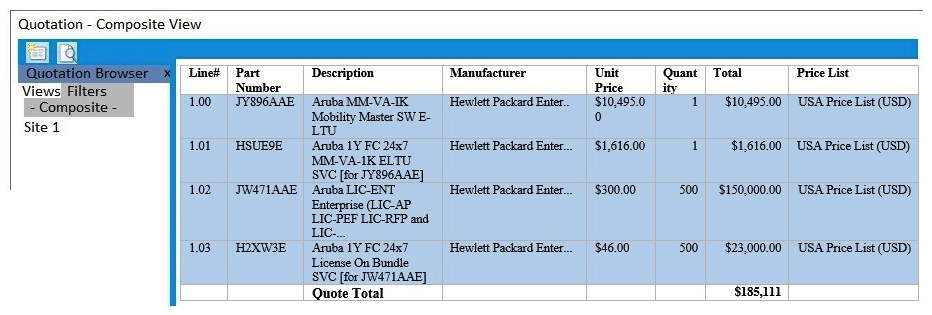
A customer has an existing Aruba network, which currently supports up to 9,000 wireless client devices. The existing network includes these components: Four 7210 MCs Five 7030 MCs 200 AP-303HRs 300 AP-345s The customer wants to convert to an ArubaOS 8.x architecture. The architect plans to deploy a virtual MM. Which exhibit shows the correct BOM for the MM?


A) A customer has an existing Aruba network, which currently supports up to 9,000 wireless client devices. The existing network includes these components: Four 7210 MCs Five 7030 MCs 200 AP-303HRs 300 AP-345s The customer wants to convert to an ArubaOS 8.x architecture. The architect plans to deploy a virtual MM. Which exhibit shows the correct BOM for the MM? A)    B)    C)    D)
B) A customer has an existing Aruba network, which currently supports up to 9,000 wireless client devices. The existing network includes these components: Four 7210 MCs Five 7030 MCs 200 AP-303HRs 300 AP-345s The customer wants to convert to an ArubaOS 8.x architecture. The architect plans to deploy a virtual MM. Which exhibit shows the correct BOM for the MM? A)    B)    C)    D)
C) A customer has an existing Aruba network, which currently supports up to 9,000 wireless client devices. The existing network includes these components: Four 7210 MCs Five 7030 MCs 200 AP-303HRs 300 AP-345s The customer wants to convert to an ArubaOS 8.x architecture. The architect plans to deploy a virtual MM. Which exhibit shows the correct BOM for the MM? A)    B)    C)    D)
D) A customer has an existing Aruba network, which currently supports up to 9,000 wireless client devices. The existing network includes these components: Four 7210 MCs Five 7030 MCs 200 AP-303HRs 300 AP-345s The customer wants to convert to an ArubaOS 8.x architecture. The architect plans to deploy a virtual MM. Which exhibit shows the correct BOM for the MM? A)    B)    C)    D)

E) B) and C)
F) A) and B)

Correct Answer

verifed

verified

What is one reason that an architect might choose to use pico-cell coverage rather than overhead in a stadium?


A) to avoid major rewiring and construction concerns
B) to save money by using less powerful and less expensive APs in the deployment
C) to support a higher device density with a higher level of channel reuse
D) to maximize coverage per-AP through the use of calculated directional antennas

E) None of the above
F) A) and B)

Correct Answer

verifed

verified

A retailer currently has two redundant ClearPass C2000 DL360 Gen9 hardware appliances and two perpetual 1K Access licenses. The customer uses ClearPass to authenticate employee wireless devices and other corporate wireless devices. ClearPass logs indicate that peak license usage is currently 1900. The customer now wants to add a guest access solution. Guests will connect to an open SSID and redirected to a portal which they can use to self-register and log in. The customer anticipates that up to 1550 guest devices will connect at the same time. The customer requires the most cost-effective solution that will meet the requirements. What should the network architect recommend for this solution?


A) Two 1K Guest licenses
B) 1K+500 Access licenses; Two 1K Onboard licenses
C) 1K+500 Access licenses
D) 1K+500 Access licenses; 1K+500 Guest licenses

E) A) and C)
F) None of the above

Correct Answer

verifed

verified

Refer to the exhibit. Refer to the exhibit.   A museum wants to add full 802.11ac wireless coverage across the building, which is about 210 feet (64 m)  by 330 feet (100m) . The museum has 15-foot (4,6 m)  ceilings and stone interior walls. The network needs to support up to 600 wireless guest devices. The exhibit also shows a preliminary plan for AP locations. The museum has eight Ethernet drops in the lobby and gift shop, but has otherwise not been wired. What is one recommendation that the architect should make to ensure a successful deployment? A)  use of directional antennas to avoid lost signal B)  addition of a writing closet closer to the north side C)  use of at least CAT5 cable to connect to the APs D)  addition of about 10 APs to achieve adequate density A museum wants to add full 802.11ac wireless coverage across the building, which is about 210 feet (64 m) by 330 feet (100m) . The museum has 15-foot (4,6 m) ceilings and stone interior walls. The network needs to support up to 600 wireless guest devices. The exhibit also shows a preliminary plan for AP locations. The museum has eight Ethernet drops in the lobby and gift shop, but has otherwise not been wired. What is one recommendation that the architect should make to ensure a successful deployment?


A) use of directional antennas to avoid lost signal
B) addition of a writing closet closer to the north side
C) use of at least CAT5 cable to connect to the APs
D) addition of about 10 APs to achieve adequate density

E) All of the above
F) A) and B)

Correct Answer

verifed

verified

Refer to the exhibit. Refer to the exhibit.       A customer needs a wired network upgrade and has complained about performance issues. The architect has collected information about traffic flow on several switch ports in different locations across the network, and the results are shown in the exhibit. Each of these ports is a 1Gbps port. What can the architect conclude? A)  None of these ports show any periods of congestion. B)  Port 1 shows periods of congestion, other ports are not congested. C)  Port 3 shows periods of congestion, other ports are not congested. D)  All of the ports show serious congestion. Refer to the exhibit.       A customer needs a wired network upgrade and has complained about performance issues. The architect has collected information about traffic flow on several switch ports in different locations across the network, and the results are shown in the exhibit. Each of these ports is a 1Gbps port. What can the architect conclude? A)  None of these ports show any periods of congestion. B)  Port 1 shows periods of congestion, other ports are not congested. C)  Port 3 shows periods of congestion, other ports are not congested. D)  All of the ports show serious congestion. Refer to the exhibit.       A customer needs a wired network upgrade and has complained about performance issues. The architect has collected information about traffic flow on several switch ports in different locations across the network, and the results are shown in the exhibit. Each of these ports is a 1Gbps port. What can the architect conclude? A)  None of these ports show any periods of congestion. B)  Port 1 shows periods of congestion, other ports are not congested. C)  Port 3 shows periods of congestion, other ports are not congested. D)  All of the ports show serious congestion. A customer needs a wired network upgrade and has complained about performance issues. The architect has collected information about traffic flow on several switch ports in different locations across the network, and the results are shown in the exhibit. Each of these ports is a 1Gbps port. What can the architect conclude?


A) None of these ports show any periods of congestion.
B) Port 1 shows periods of congestion, other ports are not congested.
C) Port 3 shows periods of congestion, other ports are not congested.
D) All of the ports show serious congestion.

E) B) and C)
F) A) and C)

Correct Answer

verifed

verified

A customer has multiple medium and large branch sites, each of which requires between 8 and 16 APs and supports between 200 and 600 wireless clients. Every branch site has an internet connection, which it uses to reach the central data center. The customer would prefer the WAN links to be optimized in the solution. Each side handles between 1 and 2 Gbps of traffic, most of which goes to the central data center. The data center has 7210 controllers for terminating the VPN connections. Which branch office solution best meets the customer needs?


A) CAPs and branch office controllers with an SD-WAN license
B) IAPs and no branch office controllers
C) CAPs and branch office controllers
D) RAPs and no branch office controllers

E) A) and B)
F) A) and C)

Correct Answer

verifed

verified

Refer to the exhibit. Refer to the exhibit.   A mall has an existing Aruba solution with 15 AP-335s. The mall now wants to add Meridian and location-based services, in particular blue dot wayfinding. The customer plans to use the built-in beacon in the existing AP radios. These Meridian licenses have been proposed: 1x Aruba Meridian Maps 1x Aruba Meridian Blue Dot Nav Which concern should the architect raise about this plan? A)  Separate beacons should be deployed to provide proper coverage for wayfinding. B)  Only the Blue Dot Nav license is required to meet the customer requirements. C)  The customer requires wireless sensors to manage the beacons in the AP radios. D)  The existing AP radios do not support beacon functionality. A mall has an existing Aruba solution with 15 AP-335s. The mall now wants to add Meridian and location-based services, in particular blue dot wayfinding. The customer plans to use the built-in beacon in the existing AP radios. These Meridian licenses have been proposed: 1x Aruba Meridian Maps 1x Aruba Meridian Blue Dot Nav Which concern should the architect raise about this plan?


A) Separate beacons should be deployed to provide proper coverage for wayfinding.
B) Only the Blue Dot Nav license is required to meet the customer requirements.
C) The customer requires wireless sensors to manage the beacons in the AP radios.
D) The existing AP radios do not support beacon functionality.

E) A) and B)
F) A) and C)

Correct Answer

verifed

verified

A customer requires new MCs for a large multi-site network with about 600 AP-345s and 30,000 wireless clients. The customer requires redundancy for the MCs with each MC being able to handle the full load in a failover situation. The network should be able to sustain the loss of a controller with stateful failover within seconds. It should be able to undergo software upgrades without downtime. The architect has recommended two 7240XM MCs. The customer points out that 7220 MCs can support enough APs and wonders why the architect recommended the 7240XMs. What should the architect explain?


A) The 7240XMs MCs are required to support the large number of wireless clients in this network.
B) The 7240XMs MCs support 40GbE ports, which are desirable for future proofing.
C) The 7240XMs MCs can support full CPSec tunnels with this number of APs, while the 7220 MCs cannot.
D) The 7240XMs MCs have more advanced clustering and availability capabilities than the 7220s MCs.

E) All of the above
F) None of the above

Correct Answer

verifed

verified

Refer to the exhibits. Exhibit 1. Existing wiring plan: Refer to the exhibits. Exhibit 1. Existing wiring plan:   Exhibit 2. Current proposal:   A customer has a building that needs a switch upgrade. The customer would like at least 20Gbps for the uplink bandwidth out of each closet. The building writing plan is shown in Exhibit 1. The customer will not consider any cable upgrades at this point. The current proposal is shown in Exhibit 2. Which correction must architect make to the proposal to meet the customer requirements? A)  Change the SR transceivers for each link between the writing closet switches and the network core to LRM transceivers. B)  Add an aggregation layer, and connect writing closet switches to the aggregation layer on Smart Rate ports. C)  Add an aggregation layer, and connect writing closet switches to the aggregation layer with SFP+ SR transceivers. D)  Add a mode conditioning cable for each link between the writing closet switches and the network core. Exhibit 2. Current proposal: Refer to the exhibits. Exhibit 1. Existing wiring plan:   Exhibit 2. Current proposal:   A customer has a building that needs a switch upgrade. The customer would like at least 20Gbps for the uplink bandwidth out of each closet. The building writing plan is shown in Exhibit 1. The customer will not consider any cable upgrades at this point. The current proposal is shown in Exhibit 2. Which correction must architect make to the proposal to meet the customer requirements? A)  Change the SR transceivers for each link between the writing closet switches and the network core to LRM transceivers. B)  Add an aggregation layer, and connect writing closet switches to the aggregation layer on Smart Rate ports. C)  Add an aggregation layer, and connect writing closet switches to the aggregation layer with SFP+ SR transceivers. D)  Add a mode conditioning cable for each link between the writing closet switches and the network core. A customer has a building that needs a switch upgrade. The customer would like at least 20Gbps for the uplink bandwidth out of each closet. The building writing plan is shown in Exhibit 1. The customer will not consider any cable upgrades at this point. The current proposal is shown in Exhibit 2. Which correction must architect make to the proposal to meet the customer requirements?


A) Change the SR transceivers for each link between the writing closet switches and the network core to LRM transceivers.
B) Add an aggregation layer, and connect writing closet switches to the aggregation layer on Smart Rate ports.
C) Add an aggregation layer, and connect writing closet switches to the aggregation layer with SFP+ SR transceivers.
D) Add a mode conditioning cable for each link between the writing closet switches and the network core.

E) A) and B)
F) A) and C)

Correct Answer

verifed

verified

Refer to the exhibit. Refer to the exhibit.   A customer needs a network upgrade. The customer has these availability requirements for wireless access: One MC and one core switch can fail with immediate, stateful failover for client connections. Network upgrades can occur without the requirement of a maintenance window. The exhibit shows the architecture plan. Which technologies should the architect recommend? A)  Clustering on MCs and VRRP on Core switches B)  VRRP on MCs and VSF on Core switches C)  VRRP on both MCs and Core switches D)  Clustering on MCs and VSF on Core switches A customer needs a network upgrade. The customer has these availability requirements for wireless access: One MC and one core switch can fail with immediate, stateful failover for client connections. Network upgrades can occur without the requirement of a maintenance window. The exhibit shows the architecture plan. Which technologies should the architect recommend?


A) Clustering on MCs and VRRP on Core switches
B) VRRP on MCs and VSF on Core switches
C) VRRP on both MCs and Core switches
D) Clustering on MCs and VSF on Core switches

E) A) and D)
F) All of the above

Correct Answer

verifed

verified

A customer has multiple, very small branch sites that require just one or two APs each. The office has a local Internet connection, but the traffic is destined to the corporate data center, which has an Aruba wireless solution. Which branch office solution best meets the customer needs?


A) RAPs and 7005 branch office controllers with an SD-WAN license
B) RAPs and no branch office controllers
C) CAPs and 7005 branch office controllers
D) IAPs and 7005 branch office controllers with an SD-WAN license

E) None of the above
F) A) and D)

Correct Answer

verifed

verified

D

Refer to the exhibit. Refer to the exhibit.   A customer has these availability requirements: loss of one controller with stateful failover and without impact on wireless client connectivity loss of one core switch without loss of connectivity for any endpoints or APs in the building loss of any one switch-to-switch or MC-to-switch link without loss of connectivity for any endpoints or APs in the building and with minimal impact on infrastructure functionality loss of any one access switch with minimal impact to wireless client connectivity The exhibit shows the current plan for the topology. Which change should the architect make to the plan to provide better support for the customer availability requirements? A)  Use two 40GbE DACs for the VSF link between the core switches. B)  Add VLANs 11 and 15 to the MC connections to ensure both MCs can manage any of the APs. C)  Add 120 additional AP licenses, so that each MC can support all the APs even if the other MC fails. D)  Change the 40GbE DAC on the 5406R switch to a stacking cable with stacking module. A customer has these availability requirements: loss of one controller with stateful failover and without impact on wireless client connectivity loss of one core switch without loss of connectivity for any endpoints or APs in the building loss of any one switch-to-switch or MC-to-switch link without loss of connectivity for any endpoints or APs in the building and with minimal impact on infrastructure functionality loss of any one access switch with minimal impact to wireless client connectivity The exhibit shows the current plan for the topology. Which change should the architect make to the plan to provide better support for the customer availability requirements?


A) Use two 40GbE DACs for the VSF link between the core switches.
B) Add VLANs 11 and 15 to the MC connections to ensure both MCs can manage any of the APs.
C) Add 120 additional AP licenses, so that each MC can support all the APs even if the other MC fails.
D) Change the 40GbE DAC on the 5406R switch to a stacking cable with stacking module.

E) B) and C)
F) A) and D)

Correct Answer

verifed

verified

Compare the scenarios below. For which scenario do AP-365s meet the needs?


A) The customer needs APs mounted to a concrete building exterior to provide coverage in a 90 foot (27m) radius from the building.
B) The customer needs APs for an indoor high density environment in which the customer prefers dual 5GHz operation.
C) The customer needs to mount APs in an outdoor area, but that area only has fiber cable available.
D) The customer needs APs for an indoor stadium that requires overhead coverage and directional antennas.

E) A) and D)
F) All of the above

Correct Answer

verifed

verified

Case study A retailer needs a wireless and wired network upgrade, as well as an authentication and access control solution for a network that includes a main office with a three-floor building and six branch sites. The branch users all use resources at the main corporate office. Branch office employees will use wireless connections. At the main office, employees use wired and wireless connections. The customer wants the strongest authentication for employee wireless connections. It is also important that the MC role-based firewall can implement consistent access controls on employee connections no matter where the employees connect and no matter how they connect (wirelessly or, at the main site, wired) . The customer also needs to provide complimentary wireless access for guests. Guest should be redirected to a portal, through which they can register and login. The customer would like two SSIDs, CompanyXEmployee and CompanyXGuest. The company wants to divide employees in two groups, managers and staff. In the corporate network, managers should only have access to Server Group Managers and staff should only have access to Server Group Staff. Each server group includes necessary services such as domain and DHCP, as well as servers that the employees access to do their jobs. All employees should also have access to the Internet. Guests should only have HTTP and HTTPS access, and only to the Internet. The customer has: • a maximum of 1000 employee devices • a maximum of 100 guest devices at the same time • 500 devices on wired ports at the main site, which will be supported by 12 new AOS-Switches (mostly employee laptops, as well as a few non-802.1X capable printers, which should just communicate with print servers) The devices used by employees include 450 company-issued laptops, which the company wants to screen for security issues and violations of security policies. All authentications are assumed to be concurrent. To fulfill the requirements for the wireless network upgrade, the architect plans to propose: • 5 RAPs at each of 6 branch sites • 60 APs at the main site The architect will also propose an MM and ClearPass. The architect still needs to plan the Mobility Controllers (MCs) . The customer requires high availability for wireless services and redundancy for the MCs. If a single MC fails, the network must continue to function without impact. If an MC fails, the customer must also receive a replacement component for the failed component by the next business day so that their IT staff can install it and get the network back to normal operation as soon as possible. Software upgrades must also be seamless, without the introduction of any downtime for wireless services, and the customer needs to be able to obtain the latest software over the lifetime of the solution for the next several years. Which plan for the VLANs assigned to users at the main site follows the best practices? (Note that the infrastructure could have additional VLANs in various locations; this plan refers only to user VLANs.)


A) VLAN 10 for wired and wireless manager devices; VLAN 11 for wired and wireless staff devices; VLAN 12 for all wireless guest devices
B) VLAN 10-12 for wireless employee devices on Floors 1-3 (divided by floor) ; VLANs 13-15 for wireless guest devices on Floors 1-3; VLANs 16-18 for wired employee devices on Floors 1-3
C) VLAN 10 for all wireless devices; VLANs 12-14 for wired employee devices on Floors 1-3 (divided by floor)
D) VLAN 10 for wireless employee devices; VLAN 11 for wireless guest devices; VLANs 12-14 for wired employee devices on Floors 1-3 (divided by floor)

E) B) and C)
F) B) and D)

Correct Answer

verifed

verified

A

Case study A retailer needs a wireless and wired network upgrade, as well as an authentication and access control solution for a network that includes a main office with a three-floor building and six branch sites. The branch users all use resources at the main corporate office. Branch office employees will use wireless connections. At the main office, employees use wired and wireless connections. The customer wants the strongest authentication for employee wireless connections. It is also important that the MC role-based firewall can implement consistent access controls on employee connections no matter where the employees connect and no matter how they connect (wirelessly or, at the main site, wired) . The customer also needs to provide complimentary wireless access for guests. Guest should be redirected to a portal, through which they can register and login. The customer would like two SSIDs, CompanyXEmployee and CompanyXGuest. The company wants to divide employees in two groups, managers and staff. In the corporate network, managers should only have access to Server Group Managers and staff should only have access to Server Group Staff. Each server group includes necessary services such as domain and DHCP, as well as servers that the employees access to do their jobs. All employees should also have access to the Internet. Guests should only have HTTP and HTTPS access, and only to the Internet. The customer has: a maximum of 1000 employee devices a maximum of 100 guest devices at the same time 500 devices on wired ports at the main site, which will be supported by 12 new AOS-Switches (mostly employee laptops, as well as a few non-802.1X capable printers, which should just communicate with print servers) The devices used by employees include 450 company-issued laptops, which the company wants to screen for security issues and violations of security policies. All authentications are assumed to be concurrent. To fulfill the requirements for the wireless network upgrade, the architect plans to propose: 5 RAPs at each of 6 branch sites 60 APs at the main site The architect will also propose an MM and ClearPass. The architect still needs to plan the Mobility Controllers (MCs) . The customer requires high availability for wireless services and redundancy for the MCs. If a single MC fails, the network must continue to function without impact. If an MC fails, the customer must also receive a replacement component for the failed component by the next business day so that their IT staff can install it and get the network back to normal operation as soon as possible. Software upgrades must also be seamless, without the introduction of any downtime for wireless services, and the customer needs to be able to obtain the latest software over the lifetime of the solution for the next several years. Which plan for authentication meets the customer needs?


A) Employee SSID = WPA2-802.1X, Guest SSID = WPA2-PSK, Wired edge ports = No authentication
B) Employee SSID = WPA2-802.1X, Guest SSID = Captive portal, Wired edge ports = No authentication
C) Employee SSID = WPA2-802.1X, Guest SSID = Captive portal, Wired edge ports = 802.1X + MAC-Auth
D) Employee SSID = WPA2-PSK, Guest SSID = MAC-Auth, Wired edge ports = MAC-Auth

E) All of the above
F) A) and B)

Correct Answer

verifed

verified

Showing 1 - 20 of 36

Related Exams

Show Answer